Homemade Apple Cider Vinegar with the Mother
How to make apple cider vinegar at home from whole apples, sugar and water, started with raw vinegar or a vinegar mother from your last batch. About 20 minutes of work, then 2-3 months of fermentation.
Equipment
- 8-liter glass jar or dispenser
- Wooden spoon
- Cheesecloth
Ingredients
- 5 ½ lb apples washed and quartered, with peel, cores and seeds, 2.5 kg
- 12 ½ cups water filtered, or boiled and cooled, 3 liters
- 1 cup sugar 200 g
- 2 cups apple cider vinegar raw, unfiltered, with the mother, or a palm-sized vinegar mother plus 1 1/2 cups of its vinegar, 500 ml
Instructions
- Wash the apples and cut them into quarters, keeping the peel, cores and seeds. Cut away any rotten or moldy parts.
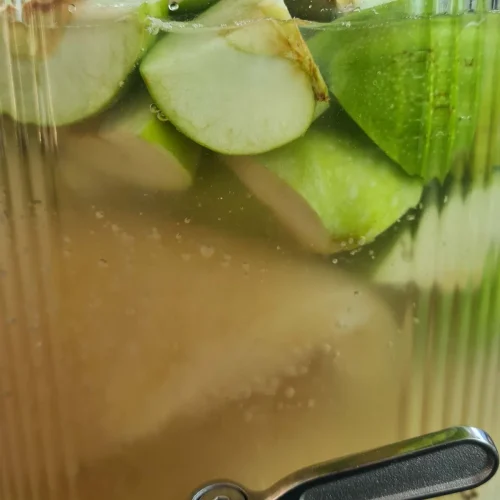
- Put the sugar and the starter (the raw vinegar, or the mother with its vinegar) into a clean, wide glass jar or dispenser of about 8 liters. Add the apples, pour in the water and stir with a wooden spoon until the sugar dissolves. Fill the jar no more than three quarters full.
- Cover with a clean cotton towel or several layers of cheesecloth, secure with a rubber band, and keep in a shady spot, ideally at 18-27 °C.
- For the first 3 weeks, stir every day with the wooden spoon and press the apples back under the liquid.
- After 3-4 weeks, when the bubbling slows and the apples sink, strain them out (recommended for a first batch) or leave them in, as I do.
- Leave the jar undisturbed so a new mother can form on top. From week 6-8, taste it: it is ready when it is clearly sour, with no sweetness or alcohol left. In a cool room this can take a couple of months.
- Strain through cheesecloth into clean glass bottles, fill them to the top and close them. Keep the new mother in a jar with some vinegar for your next batch.
Notes
The acidity of homemade vinegar is unknown and often under 5%, so do not use it for canning or for pickles stored at room temperature; it is great for salads, cooking and fridge pickles. Throw the batch away if you see fuzzy green, blue, black or pink mold; a flat white film (kahm yeast) can be skimmed off. Use only glass, food-grade plastic or stainless steel, never brass or copper. Drink it only diluted (1 tablespoon in a large glass of water). About 3 kcal per tablespoon.