What Is Erythritol? How It’s Made, How to Bake With It, and Is It Safe
Erythritol is a sugar alcohol made by fermenting glucose with a yeast. It’s about 70% as sweet as sugar, counts as 0 calories on US nutrition labels, and doesn’t raise blood sugar, but it doesn’t bake like sugar, and large amounts can upset your stomach. Below you’ll find what erythritol is made from, how much to use instead of sugar, what the heart studies actually show, and who should be careful with it.
I started baking with erythritol back in 2015, through a Romanian sweetener called Green Sugar, which is erythritol with a little stevia. My chocolate magic custard cake was the first recipe I made with it, and honestly, I couldn’t taste the difference from sugar. Since then it has gone into puddings, creams and sugar-free cakes. I wrote this guide because erythritol has been in the news with scary headlines about heart attacks, and it’s worth separating what has been shown from what hasn’t.
Erythritol at a glance
- What it is: a sugar alcohol (polyol) made by fermenting glucose, usually from corn; fruit contains only tiny amounts.
- Sweetness: about 70% as sweet as sugar, so pure erythritol needs about 1⅓ cups for every cup of sugar.
- Calories and blood sugar: 0 calories per gram on US labels; in studies, 20-75 g didn’t raise blood glucose or insulin.
- Side effects: above roughly 0.5 g per kg of body weight a day it can cause diarrhea, a limit kids reach quickly.
- Heart health: studies found associations, not cause and effect; until better studies are in, use it in moderation.
Table of Contents
- What Is Erythritol?
- How Your Body Handles Erythritol
- Baking With Erythritol: How Much to Use Instead of Sugar
- Is Erythritol Safe? What the Studies Say
- Erythritol for Diabetes and Keto
- Erythritol Blends: Stevia and Monk Fruit
- Frequently Asked Questions
- Sources
What Is Erythritol?
Erythritol belongs to the same family as xylitol, sorbitol and maltitol: the sugar alcohols, or polyols. Despite the name, there’s no alcohol in it in the drinking sense; “sugar alcohol” describes the shape of the molecule. It looks and pours like granulated sugar, tastes clean and sweet, and has a slight cooling effect on the tongue.
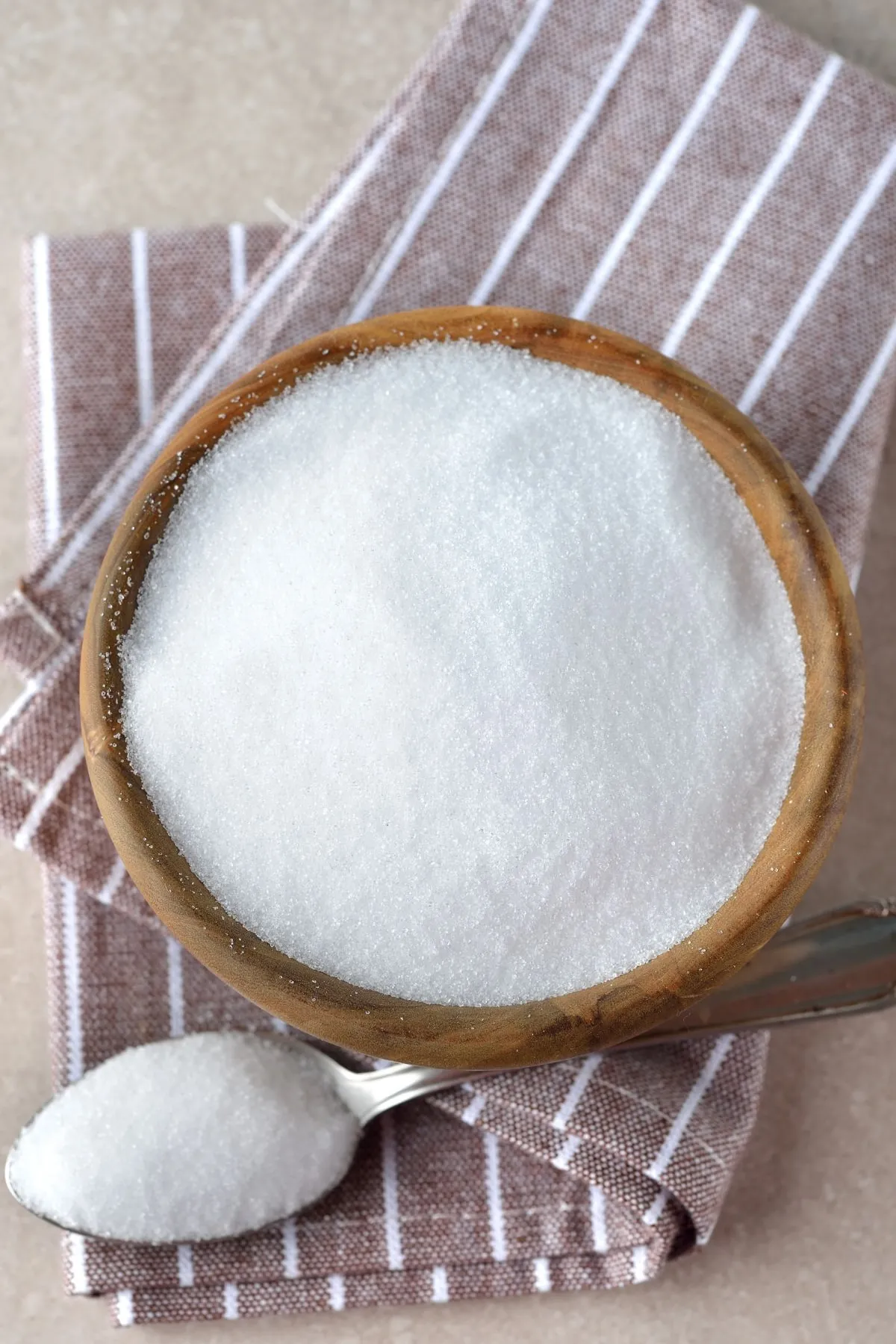
What is erythritol made from?
Erythritol occurs naturally in pears, melons, grapes, wine and soy sauce, but only in milligram amounts. A whole pear has a few milligrams at most, while a teaspoon of erythritol weighs around 4 grams, so it can’t be economically extracted from fruit.
The erythritol you buy is made by fermenting glucose, usually from corn starch, with a food-grade yeast, then purifying and drying it to at least 99% purity. Your own body also makes small amounts of erythritol from glucose, which matters a lot when you read the heart studies below.
Is erythritol natural?
Partly. The molecule exists in nature and in your body, but the product on the shelf comes from industrial fermentation. “Made by fermenting glucose” is accurate; “extracted from fruit” is not.
How Your Body Handles Erythritol
This is what sets erythritol apart from other sugar alcohols. Between 60% and 90% of it is absorbed in the small intestine and then leaves the body unchanged in urine, mostly within 24 hours. Your body doesn’t burn it for energy, which is why the FDA allows 0 calories per gram on labels and why its glycemic index is 0.
The small part that reaches the colon barely ferments, so erythritol is much easier on the stomach than xylitol. In one study, 20 g and 35 g of erythritol in a drink caused no symptoms, while 35 g of xylitol caused watery stools.
| Erythritol | Sugar | Xylitol | |
|---|---|---|---|
| Sweetness | ~70% | 100% | ~100% |
| Calories (US label) | 0 per gram | 4 per gram | 2.4 per gram |
| Glycemic index | 0 | ~65 | 13 |
| In baking | doesn’t brown | browns, caramelizes | browns slightly |
| Watch out for | digestive upset in large amounts | added sugar | digestive upset; toxic to dogs |
On US labels, erythritol is counted in Total Carbohydrate and may be listed on a “Sugar Alcohol” line, which becomes mandatory when the package makes a sugar or sugar alcohol claim. That’s why keto recipes subtract it to get “net carbs”.
Baking With Erythritol: How Much to Use Instead of Sugar
Pure erythritol is less sweet than sugar, so you need about a third more for the same sweetness:
- pure erythritol: about 1⅓ cups for every cup of sugar (135-145 g for every 100 g);
- “1:1” or “cup-for-cup” blends (erythritol with stevia or monk fruit, like Lakanto Classic): the same amount as sugar;
- “2:1” blends (twice as sweet): half the amount of sugar.
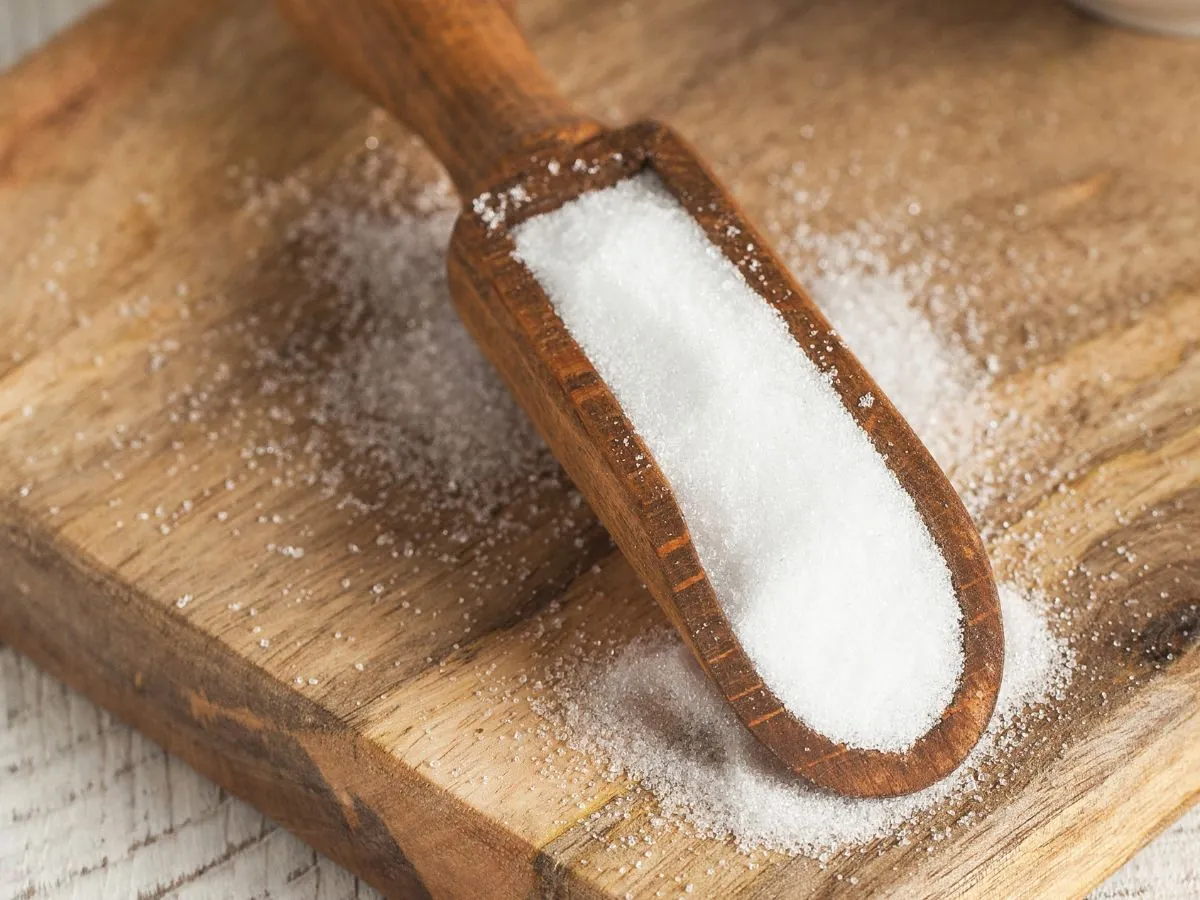
Always check the label: most “1:1” sweeteners are blends, and some popular brands have changed their formulas. Swerve, for example, now lists allulose alongside erythritol.
What erythritol does differently from sugar
- It doesn’t brown. Erythritol doesn’t take part in the Maillard reaction, so cakes and cookies come out paler. Don’t judge doneness by color; use a toothpick.
- It bakes drier. Unlike sugar, erythritol doesn’t hold on to moisture. Recipes with banana, pumpkin, yogurt or a custard layer, like my magic custard cake, hide this best.
- It recrystallizes when cold. Frostings, glazes, caramel and no-bake creams made with granulated erythritol can turn gritty in the fridge. Use powdered erythritol for anything that isn’t baked.
- It has a cooling effect. You may notice a minty coolness without any mint flavor, especially when the erythritol isn’t fully dissolved.
- It doesn’t feed yeast. In yeasted breads and rolls, keep a teaspoon of sugar or honey for the yeast, even if the rest of the sweetness comes from erythritol.
How to make powdered erythritol: blend granulated erythritol in small batches in a coffee grinder or high-speed blender, and let the dust settle before opening the lid. It gains volume as it’s ground, so measure it by weight, not by the cup.
Jams and preserves: erythritol can’t replace sugar in traditional canned jam, because the sugar is what preserves it. You can make a low-sugar jam with pectin and erythritol, then keep it in the fridge and use it within a few weeks, or freeze it.
Is Erythritol Safe? What the Studies Say
Digestive side effects
In 2023, the European Food Safety Authority (EFSA) set an acceptable daily intake of 0.5 g per kg of body weight, the level at which no diarrhea was seen. For a 150-pound adult that’s about 34 g a day, roughly a third of a cup. If you eat a lot of “sugar-free” drinks, chocolate and baked goods, you can get there without noticing.
Kids
For a 44-pound child, the limit is about 10 g a day. One slice of a cake made with 130 g of erythritol and cut into 12 pieces has about 11 g, so a single slice already goes over it. When baking for kids, use less erythritol or combine it with naturally sweet fruit.
Erythritol and heart health
A 2023 Cleveland Clinic study found that people with higher erythritol levels in their blood had a higher risk of heart attack and stroke over three years. Those people already had heart problems. That study is behind the headlines, and here’s what to know:
- It’s an association, not proof of cause. Your body makes erythritol, and makes more of it with obesity and diabetes, so high blood levels may be a sign of disease rather than of the sweetener.
- The human studies disagree. A small 2024 study (20 volunteers) saw stickier platelets after drinking 30 g of erythritol at once. A randomized 2026 study (14 volunteers, 50 g) found no such effect, but it hasn’t been peer-reviewed yet.
- Regulators: the FDA has accepted erythritol as safe (GRAS) since 2001 and says the 2023 study did not establish a causal link. EFSA reached the same conclusion.
My take: there’s no evidence that erythritol causes heart attacks, but there’s also no proof that eating a lot of it every day, for years, is fine for everyone. Until better studies come in, I treat it like sugar, as something to use in moderation, not as a free food. If you have heart disease or a high risk of it, ask your doctor.
Other cases
- Pregnancy and breastfeeding: there are no dedicated studies; the general limit of 0.5 g per kg a day applies.
- IBS: erythritol is a polyol with no tested low-FODMAP serving, so I don’t consider it suitable for the low-FODMAP diet.
- Dogs: unlike xylitol, erythritol doesn’t cause dangerous drops in blood sugar in dogs. Check labels anyway, since some blends also contain xylitol.
Erythritol for Diabetes and Keto
In studies, single doses of 20 to 75 g of erythritol didn’t raise blood glucose or insulin. That makes it popular with people watching their blood sugar, but a cake sweetened with erythritol still has flour, fruit and other carbs. If you have diabetes, talk to your doctor or dietitian before relying on it.
On keto, erythritol is the most common sweetener because it doesn’t add net carbs. You’ll find ideas in my keto desserts and sugar-free desserts, and it also sweetens my homemade pancake mix.
For teeth, a three-year study of 485 schoolchildren in Estonia found fewer cavities in kids given erythritol candies than in those given xylitol or sorbitol. That’s a good sign for sugar-free gum and candy, but erythritol doesn’t replace brushing.
Erythritol Blends: Stevia and Monk Fruit
Pure erythritol is only 70% as sweet as sugar, so many brands add a tiny amount of a very sweet extract to reach “cup-for-cup”:
- Erythritol + monk fruit (Lakanto Classic and most “monk fruit sweeteners” in US stores): mostly erythritol, with a little monk fruit extract.
- Erythritol + stevia (like Green Sugar, the one I use, only sold in Romania): mostly erythritol, with a little stevia extract (rebaudioside A).
Both swap 1:1 for sugar and bake like erythritol: no browning, a slightly drier crumb, and a gritty texture in cold creams unless you use the powdered version. I also use Green Sugar in my coconut rice pudding and my Christmas pound cake.
To compare erythritol with honey, maple syrup, dates, coconut sugar and stevia, see my guide to healthy sugar alternatives and how much to use instead of sugar.
Frequently Asked Questions
Erythritol is a sugar alcohol made by fermenting glucose with a yeast. It’s about 70% as sweet as sugar, has 0 calories per gram on US labels and doesn’t raise blood sugar.
Most erythritol is made from glucose, usually from corn, which is fermented by a food-grade yeast and then purified. It also occurs naturally in fruits like pears and melons, but only in tiny amounts.
Yes. Erythritol is a sugar alcohol, or polyol, like xylitol and sorbitol, but most of it is absorbed and leaves the body unchanged, so it causes fewer digestive problems than the others.
Use about 1 1/3 cups of pure erythritol for every cup of sugar. Cup-for-cup blends with stevia or monk fruit replace sugar in equal amounts.
Yes. Erythritol doesn’t raise blood sugar, so keto recipes subtract it from total carbs and count it as zero net carbs.
There are no studies specifically on pregnancy. The general limit of 0.5 g per kg of body weight a day applies, and it’s worth asking your doctor or midwife.
Unlike xylitol, erythritol doesn’t cause a dangerous drop in blood sugar in dogs. Check the label, though, because some blends also contain xylitol, which is toxic to dogs.
Not traditional canned jam, because sugar is what preserves it. You can make a pectin jam sweetened with erythritol and keep it in the fridge for a few weeks or in the freezer.
Sources
- EFSA, re-evaluation of erythritol (E 968) as a food additive, 2023: doi.org/10.2903/j.efsa.2023.8430
- FDA, GRAS Notice Inventory (GRN 76, 208, 382, 789): fda.gov
- FDA, Aspartame and Other Sweeteners in Food (statement on erythritol): fda.gov
- 21 CFR 101.9, nutrition labeling (calories and sugar alcohols): ecfr.gov
- Mazi T.A., Stanhope K.L., 2023, Nutrients (erythritol: metabolism, glycemia, heart): doi.org/10.3390/nu15010204
- Hootman K.C. et al., 2017, PNAS (erythritol made by the body): doi.org/10.1073/pnas.1620079114
- Storey D. et al., 2007, Eur J Clin Nutr (digestive tolerance, erythritol vs xylitol): PubMed 16988647
- Wölnerhanssen B.K. et al., 2016, Am J Physiol Endocrinol Metab (blood glucose and insulin): PubMed 27117004
- Witkowski M. et al., 2023, Nature Medicine (association with cardiovascular events): PubMed 36849732
- Witkowski M. et al., 2024, Arterioscler Thromb Vasc Biol (platelets after 30 g): doi.org/10.1161/ATVBAHA.124.321019
- Wölnerhanssen B.K. et al., 2026, medRxiv preprint, not peer-reviewed (randomized trial, platelets): doi.org/10.64898/2026.09.25.26364060
- Cramer H. et al., 2023, Frontiers in Nutrition (critique of the 2023 study): PubMed 37287998
- Honkala S. et al., 2014, Caries Research (Estonian school trial, cavities): PubMed 24852946
- Eapen A.K. et al., 2017, Food Chem Toxicol (erythritol in dogs): PubMed 28478098
- National Center for Home Food Preservation (sugar in jams): nchfp.uga.edu